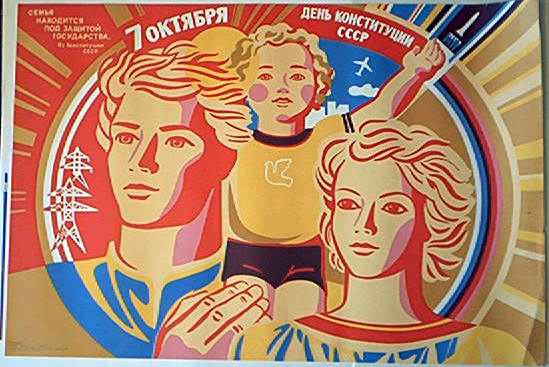
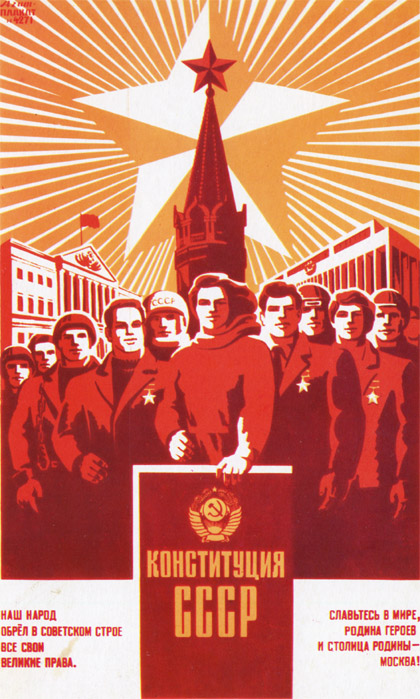
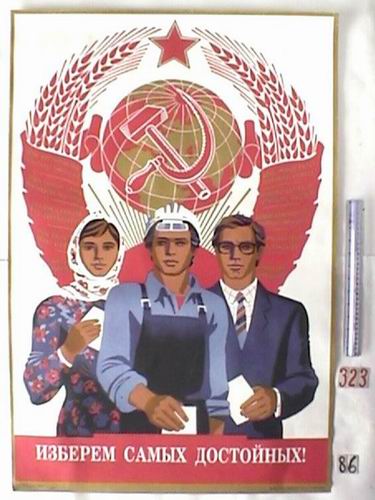
If you are one of those people who regard Communism as inherently flawed, unworkable or even evil, the contents of the Soviet Constitutions will genuinely surprise you.I will present here the prominent wordings in the various Soviet constitutions adopted at various periods. The "problematic parts" (references to the Communist Party) are marked in Red. Its enough to just scan through them to see my point.
So, get ready to start rubbing your eyes.. Yes, what I mentioned here is genuine.
Constitution (Fundamental Law) of the R.S.F.S.R.
Adopted by the Fifth All-Russia Congress of Soviets 10 July 1918
(Courtesy: Soviet-Empire.com)Part One: Declaration of Rights of the Working and Exploited PeopleChapter OneArticle 1. Russia is hereby proclaimed a Republic of Soviets of Workers', Soldiers' and Peasants' Deputies. All power, centrally and locally, is vested in these Soviets.
Article 2. The Russian Soviet Republic is established on the principle of a free union of free nations, as a federation of Soviet national republics.
Chapter ThreeArticle 4. Expressing firm determination to wrest mankind from the clutches of finance capital and imperialism, which have in this most criminal of wars drenched the world in blood, the Third Congress of Soviets unreservedly endorses Soviet policy of denouncing the secret treaties, organizing most extensive fraternization with the workers and peasants of the combatant armies and achieving at all costs by revolutionary means a democratic peace for the working people, without annexations of indemnities, on the basis of free self-determination of nations.
Chapter FourArticle 7. The Third All-Russia Congress of Soviets holds that now, in the hour of the people's resolute struggle against the exploiters, there should be no room for exploiters in any governmental agency. Power must belong fully and exclusively to the working people and their plenipotentiary representatives - the Soviets of Workers', Soldiers' and Peasants' Deputies.
Part Two: General Provisions of the Constitution of the R.S.F.S.R.Chapter FiveArticle 10. The Russian Republic is a free socialist society of all the working people of Russia. All power in the Russian Socialist Federative Soviet Republic belongs to the entire working population of the country united in urban and rural soviets.
Article 13. In order to ensure genuine freedom of conscience for the working people, the church is separated from the State, and the school from the church: and freedom of religious and anti-religious propaganda is recognized for all citizens.
Article 14. In order to ensure genuine freedom of expression for the working people, the Russian Socialist Federative Soviet Republic abolishes the dependence of the press on capital, and places at the disposal of the working class and the poor peasantry all the technical and material requisites for the publication of newspapers, pamphlets, books and all other printed matter, and guarantees their unhindered circulation throughout the country.
Article 22. The Russian Socialist Federative Soviet Republic, recognizing the equality of rights of all citizens, irrespective of their race or nationality, declares the establishment or toleration on this basis of any privileges or advantages, or any oppression of national minorities or restriction of their equality, to be contraventions of the fundamental laws of the Republic.
Part Three: The Structure of Soviet GovernmentA. Organization of the central authorityChapter SixThe All-Russia Congress of Soviets of Workers', Peasants, Cossacks' and Red Army Soldiers' DeputiesArticle 24. The All-Russia Congress of Soviets is the supreme authority of the Russian Socialist Federative Soviet Republic.
Article 25. The All-Russia Congress of Soviets is composed of representatives of urban Soviets on the basis of one deputy for every 25,000 electors, and representatives of gubernia congresses of Soviets on the basis of one deputy for every 125,000 of the population.
Part Four: Active and Passive SuffrageChapter ThirteenArticle 64. The right to elect and to be elected to soviets is enjoyed, irrespective of religion, nationality, sex, domicile, etc. by the following citizens of the Russian Socialist Federative Soviet Republic who have reached the age of eighteen by polling day:
All those who earn a living by productive and socially useful labour (as well as persons engaged in housekeeping which enables the former to work productively), viz. wage and salaried workers of all groups and categories engaged in industry, trade, agriculture, etc. and peasants and Cossack farmers who do not employ hired labour for profit;
Soldiers of the Soviet army and navy;
Citizens belonging to categories listed in Paragraphs (a) and (b) of the present article who have been to any degree incapacitated.
Article 65. The right to elect and to be elected is denied to the following persons, even if they belong to one of the categories listed above:
Persons who employ hired labour for profit;
Persons living on unearned income, such as interest on capital, profits from enterprises, receipts from property, etc.;
Private traders and commercial middle-men;
Monks and ministers of religion;
Employees and agents of the former police, the special corps of gendarmerie and the secret political police department, as well as members of the former imperial family;
Persons declared insane by legal proceeding, as well as persons in ward;
Persons condemned for pecuniary and infamous crimes to terms established by law or by a court decision.
1936 Constitution of the U.S.S.R.
Adopted December 1936
(Courtesy: Soviet-Empire.com)Chapter IThe Organization of Soviet SocietyArticle 1. The Union of Soviet Socialist Republics is a socialist state of workers and peasants.
Article 3. In the U.S.S.R. all power belongs to the working people of town and country as represented by the Soviets of Working People's Deputies.
Article 5. Socialist property in the U.S.S.R. exists either in the form of state property (the possession of the whole people), or in the form of cooperative and collective-farm property (that of a collective farm or property of a cooperative association).
Article 6. The land, its natural deposits, waters, forests, mills, factories, mines, rail, water and air transport, banks, post, telegraph and telephones, large state-organized agricultural enterprises (state farms, machine and tractor stations and the like) as well as municipal enterprises and the bulk of the dwelling houses in the cities and industrial localities, are state property, that is, belong to the whole people.
Article 8. The land occupied by collective farms is secured to them for their use free of charge and for an unlimited time, that is, in perpetuity.
Article 9. Alongside the socialist system of economy, which is the predominant form of economy in the U.S.S.R., the law permits the small private economy of individual peasants and handicraftsman based on their personal labour and precluding the exploitation of the labour of others.
Article 8. The land occupied by collective farms is secured to them for their use free of charge and for an unlimited time, that is, in perpetuity.
Article 12. In the U.S.S.R. work is a duty and a matter of honour for every able-bodied citizen, in accordance with the principle: "He who does not work, neither shall he eat."
The principle applied in the U.S.S.R. is that of socialism: "From each according to his ability, to each according to his work."
Chapter IIIThe Highest Organs of State Authority of the Union of Soviet Socialist RepublicsArticle 30. The highest organ of state authority of the U.S.S.R. is the Supreme Soviet of the U.S.S.R.
Article 31. The Supreme Soviet of the U.S.S.R. exercises all rights vested in the Union of Soviet Socialist Republics in accordance with all articles of the Constitution, in so far as they do not, by virtue of the Constitution, come within the jurisdiction of organs of the U.S.S.R. that are accountable to the Supreme Soviet of the U.S.S.R., that is, the Presidium of the Supreme Soviet of the U.S.S.R., the Council of People's Commissars of the U.S.S.R. and the People's Commissariats of the U.S.S.R.
Article 32. The legislative power of the U.S.S.R. is exercised exclusively by the Supreme Soviet of the U.S.S.R.
Article 33. The Supreme Soviet of the U.S.S.R. consists of two Chambers: the Soviet of the Union and the Soviet of Nationalities.
Article 56. The Supreme Soviet of the U.S.S.R. at a joint sitting of both Chambers, appoints the Government of the U.S.S.R., namely, the Council of People's Commissars of the U.S.S.R.
Chapter IVThe Highest Organs of State Authority of the Union RepublicsArticle 57. The highest organ of state authority of a Union Republic is the Supreme Soviet of the Union Republic.
Article 58. The Supreme Soviet of a Union Republic is elected by the citizens of the Republic for a term of four years.
The basis of representation is established by the Constitution of the Union Republic.
Article 59. The Supreme Soviet of a Union Republic is the sole legislative organ of the Republic.
Article 63. The Supreme Soviet of a Union Republic appoints the Government of the Union Republic, namely, the Council of People's Commissars of the Union Republic.
Chapter XFundamental Rights and Duties of CitizensArticle 118. Citizens of the U.S.S.R. have the right to work, that is, are guaranteed the right to employment and payment for their work in accordance With its quantity and quality.
The right to work is ensured by the socialist organization of the national economy, the steady growth of the productive forces of Soviet society, the elimination of the possibility of economic crises, and the abolition of unemployment.
Article 119. Citizens of the U.S.S.R. have the right to rest and leisure. The right to rest and leisure is ensured by the reduction of the working day to seven hours for the overwhelming majority of the workers, the institution of annual vacations with full pay for workers and employees and the provision of a wide network of sanatoria, rest homes and clubs for the accommodation of the working people.
Article 120. Citizens of the U.S.S.R. have the right to maintenance in old age and also in case of sickness or loss of capacity to work. This right is ensured by the extensive development of social insurance of workers and employees at state expense, free medical service for the working people and the provision of a wide network of health resorts for the use of the working people.
Article 121. Citizens of the U.S.S.R. have the right to education. This right is ensured by universal, compulsory elementary education; by education, including higher education, being free of charge; by the system of state stipends for the overwhelming majority of students in the universities and colleges; by instruction in schools being conducted in the native language, and by the organization in the factories, state farms, machine and tractor stations and collective farms of free vocational, technical and agronomic training for the working people.
Article 122. Women in the U.S.S.R. are accorded equal rights with men in all spheres of economic, state, cultural, social and political life. The possibility of exercising these rights is ensured to women by granting them an equal right with men to work, payment for work, rest and leisure, social insurance and education, and by state protection of the interests of mother and child, pre-maternity and maternity leave with full pay, and the provision of a wide network of maternity homes, nurseries and kindergartens.
Article 123. Equality of rights of citizens of the U.S.S.R., irrespective of their nationality or race, in all spheres of economic, state, cultural, social and political life, is an indefeasible law. Any direct or indirect restriction of the rights of, or, conversely, any establishment of direct or indirect privileges for, citizens on account of their race or nationality, as well as any advocacy of racial or national exclusiveness or hatred and contempt, is punishable by law.
Article 126. In conformity with the interests of the working people, and in order to develop the organizational initiative and political activity of the masses of the people, citizens of the U.S.S.R. are ensured the right to unite in public organizations--trade unions, cooperative associations, youth organizations,' sport and defence organizations, cultural, technical and scientific societies; and the most active and politically most conscious citizens in the ranks of the working class and other sections of the working people unite in the
Communist Party of the Soviet Union (Bolsheviks), which is the vanguard of the working people in their struggle to strengthen and develop the socialist system and is the leading core of all organizations of the working people, both public and state.
Chapter XIThe Electoral SystemArticle 134. Members of all Soviets of Working People's Deputies--of the Supreme Soviet of the U.S.S.R., the Supreme Soviets of the Union Republics, the Soviets of Working People's Deputies of the Territories and Regions, the Supreme Soviets of the Autonomous Republics, and Soviets of Working People's Deputies of Autonomous Regions, area, district, city and rural (station, village, hamlet, kishlak, aul) Soviets of Working People's Deputies--are chosen by the electors on the basis of universal, direct and equal suffrage by secret ballot.
Article 135. Elections of deputies are universal: all citizens of the U.S.S.R. who have reached the age of eighteen, irrespective of race or nationality, religion, educational and residential qualifications, social origin, property status or past activities, have the right to vote in the election of deputies and to be elected, with the exception of insane persons and persons who have been convicted by a court of law and whose sentences include deprivation of electoral rights.
Article 136. Elections of deputies are equal: each citizen has one vote; all citizens participate in elections on an equal footing.
Article 137. Women have the right to elect and be elected on equal terms with men.
Article 138. Citizens serving in the Red Army have the right to elect and be elected on equal terms with all other citizens.
Article 139. Elections of deputies are direct: all Soviets of Working People's Deputies, from rural and city Soviets of Working People's Deputies to the Supreme Soviet of the U.S.S.R., inclusive, are elected by the citizens by direct vote.
Article 140. Voting at elections of deputies is secret.
Article 141. Candidates for election are nominated according to electoral areas. The right to nominate candidates is secured to public organizations and societies of the working people:
Communist Party organizations, trade unions, cooperatives, youth organizations and cultural societies.
Article 142. It is the duty of every deputy to report to his electors on his work and on the work of the Soviet of Working People's Deputies, and he is liable to be recalled at any time in the manner established by law upon decision of a majority of the electors.
Chapter XIII
Procedure for Amending the Constitution
Article 146. The Constitution of the U.S.S.R. may be amended only by decision of the Supreme Soviet of the U.S.S.R. adopted by a majority of not less than two-thirds of the votes cast in each of its Chambers. |
|
1977 Constitution of the U.S.S.R.
Adopted October 1977
(Courtesy: International Constitutional Law )
Part I Principles of Social Structure and Policy
Chapter 1 Political System
Article 1
The Union of Soviet Socialist Republics is a socialist state of the whole people, expressing the will and interests of the workers, peasants, and intelligentsia, the working people of all the nations and nationalities of the country.
Article 2
(1) All power in the USSR belongs to the people.
(2) The people exercise state power through Soviets of People's Deputies, which constitute the political foundation of the USSR.
(3) All other state bodies are under the control of, and accountable to, the Soviets of People's Deputies.
Article 3
The Soviet state is organized and functions on the principle of democratic centralism, namely the electiveness of all bodies of state authority from the lowest to the highest, their accountability to the people, and the obligation of lower bodies to observe the decisions of higher ones. Democratic centralism combines central leadership with local initiative and creative activity and with the responsibility of the each state body and official for the work entrusted to them.
Article 4
(1) The Soviet state and all its bodies function on the basis of socialist law, ensure the maintenance of law and order, and safeguard the interests of society and the rights and freedoms of
citizens.
(2) State organizations, public organizations and officials shall observe the Constitution of the USSR and Soviet laws.
Article 5
Major matters of state shall be submitted to nationwide discussion and put to a popular vote (referendum).
Article 6
(1) The leading and guiding force of the Soviet society and the nucleus of its political system, of all state organizations and public organizations, is the Communist Party of the Soviet Union. The CPSU exists for the people and serves the people.
(2) The Communist Party, armed with Marxism-Leninism, determines the general perspectives of the development of society and the course of the home and foreign policy of the USSR, directs the great constructive work of the Soviet people, and imparts a planned, systematic and theoretically substantiated character to their struggle for the victory of communism.
(3) All party organizations shall function within the framework of the Constitution of the USSR.
Article 7
Trade unions, the All-Union Leninist Young Communist League cooperatives, and other public organizations, participate, in accordance with the aims laid down in their rules, in managing state and public affairs, and in deciding political, economic, and social an cultural matters.
Chapter 7 Basic Rights, Freedoms, Duties
Article 39 [Freedom]
(1) Citizens of the USSR enjoy in full the social, economic, political and personal rights and freedoms proclaimed and guaranteed by the Constitution of the USSR and by Soviet laws. The socialist system ensures enlargement of the rights and freedoms of citizens and continuous improvement of their living standards as social, economic, and cultural development programs are fulfilled.
(2) Enjoyment by citizens of their rights and freedoms must not be to the detriment of the interests of society or the state, or infringe the rights of other citizens.
Article 43 [Welfare]
(1) Citizens of the USSR have the right to maintenance in old age, in sickness, and in the event of complete or partial disability or loss of the breadwinner.
(2) The right is guaranteed by social insurance of workers and other employees and collective farmers; by allowances for temporary disability; by the provision by the state or by collective farms of retirement pensions, disability pensions, and pensions for loss of the breadwinner; by providing employment for the partially disabled; by care for the elderly and the disabled; and by other forms of social security.
Article 44 [Housing]
(1) Citizens of the USSR have the rights to housing.
(2) This right is ensured by the development and upkeep of state and socially-owned housing; by assistance for cooperative and individual house building; by fair distribution, under public control, of the housing that becomes available through fulfillment of the program of building well-appointed dwellings, and by low rents and low charges for utility services. Citizens of the USSR shall take good care of the housing allocated to them.
Article 45 [Education]
(1) Citizens of the USSR have the right to education.
(2) This right is ensured by free provision of all forms of education, by the institution of universal, compulsory secondary education, and broad development of vocational, specialized secondary, and higher education, in which instruction is oriented toward practical activity and production; by the development of extramural, correspondence and evening courses, by the provision of state scholarships and grants and privileges for students; by the free issue of school textbooks; by the opportunity to attend a school where teaching is in the native language; and by the provision of facilities for self-education.
Article 46 [Culture]
(1) Citizens of the USSR have the right to enjoy cultural benefits.
(2) This rights is ensured by broad access to the cultural treasures of their own land and of the world that are preserved in state and other public collections; by the development and fair distribution of cultural and educational institutions throughout the country; by developing television and radio broadcasting and the publishing of books, newspapers and periodicals, and by extending the free library service; and by expanding cultural exchanges with other countries.
Article 47 [Research]
(1) Citizens of the USSR, in accordance with the aims of building communism, are guaranteed freedom of scientific, technical, and artistic work. This freedom is ensured by broadening scientific research, encouraging invention and innovation, and developing literature and the arts. The state provides the necessary material conditions for this and support for voluntary societies and unions of workers in the arts, organizes introduction of inventions and innovations in production and other spheres of activity.
(2) The rights of authors, inventors and innovators are protected by the state.
Article 48 [Public Affairs]
(1) Citizens of the USSR have the right to take part in the
management and administration of state and public affairs and in the discussion and adoption of laws and measures of All-Union and local significance.
(2) This right is ensured by the opportunity to vote and to be elected to Soviets of People's Deputies and other elective state bodies, to take part in nationwide discussions and referendums, in people's control, in the work of state bodies, public organizations, and local community groups, and in meetings at places of work or residence.
Article 49 [Proposals]
(1) Every citizen of the USSR has the right to submit proposals to state bodies and public organizations for improving their activity, and to criticize shortcomings in their work.
(2) Officials are obliged, within established time-limits, to examine citizens' proposals and requests, to reply to them, and to take appropriate action.
(3) Persecution for criticism is prohibited. Persons guilty of such persecution shall be called to account.
Article 50 [Expression]
(1) In accordance with the interests of the people and in order to strengthen and develop the socialist system, citizens of the USSR are guaranteed freedom of speech, of the press, and of assembly, meetings, street processions and demonstrations.
(2) Exercise of these political freedoms is ensured by putting public buildings, streets, and squares at the disposal of the working people and their organizations, by broad dissemination of information, and by the opportunity to use the press, television, and radio.
Article 51 [Association]
(1) In accordance with the aims of building communism, citizens of the USSR have the right to associate in public organizations that promote their political activity and initiative and satisfaction of their various interests.
(2) Public organizations are guaranteed conditions for successfully performing the functions defined in their rules.
Article 52 [Religion]
(1) Citizens of the USSR are guaranteed freedom of conscience, that is, the right to profess or not to profess any religion, and to conduct religious worship or atheistic propaganda. Incitement of hostility or hatred on religious grounds is prohibited.
(2) In the USSR, the church is separated from the state, and the school from the church.
Article 53 [Family, Marriage]
(1) The family enjoys the protection of the state.
(2) Marriage is based on the free consent of the woman and the man; the spouses are completely equal in their family relations.
(3) The state helps the family by providing and developing a broad system of child-care institutions, by organizing and improving communal services and public catering, by paying grants on the birth of a child, by providing children's allowances and benefits for large families, and other forms of family allowances and assistance.
Article 54 [Personal Freedom]
Citizens of the USSR are guaranteed inviolability of the person. No one may be arrested except by a court decision or on the warrant of a procurator.
Article 55 [Home]
Citizens of the USSR are guaranteed inviolability of the home. No one may, without lawful grounds, enter a home against the will of those residing in it.
Article 56 [Privacy]
The privacy of citizens, and of their correspondence, telephone
conversations, and telegraphic communications is protected by law.
Article 57 [Legal Remedies]
(1) Respect for the individual and protection of the rights and freedoms of citizens are the duty of all state bodies, public organizations, and officials.
(2) Citizens of the USSR have the right to protection by the courts against encroachments on their honor and reputation, life and health, and personal freedom and property.
Article 58 [Complaint]
(1) Citizens of the USSR have the right to lodge a complaint against the actions of officials, state bodies and public bodies. Complaints shall be examined according to the procedure and within the time-limit established by law.
(2) Actions by officials that contravene the law or exceed their powers, and infringe the rights of citizens, may be appealed against in a court in the manner prescribed by law.
(3) Citizens of the USSR have the right to compensation for damage resulting from unlawful actions by state organizations and public organizations, or by officials in the performance of their duties.
Article 59 [General]
(1) Citizens' exercise of their rights and freedoms is inseparable from the performance of their duties and obligations.
(2) Citizens of the USSR are obliged to observe the Constitution of the USSR and Soviet laws, comply with the standards of socialist conduct, and uphold the honor and dignity of Soviet citizenship.
Article 60 [Duty to Work]
It is the duty of, and matter of honor for, every able-bodied citizen of the USSR to work conscientiously in his chosen, socially useful occupation, and strictly to observe labor discipline. Evasion of socially useful work is incompatible with the principles of socialist society.
Article 61 [Socialist Property]
(1) Citizens of the USSR are obliged to preserve and protect socialist property. It is the duty of a citizen of the USSR to combat misappropriation and squandering of state and socially-owned property and to make thrifty use of the people's wealth.
(2) Persons encroaching in any way on socialist property shall be punished according to the law.
Article 63 [Military Service]
Military service in the ranks of the Armed Forces of the USSR is an honorable duty of Soviet citizens.
Article 64 [Peacekeeping Duty]
It is the duty of every citizen of the USSR to respect the national dignity of other citizens, and to strengthen friendship of the nations and nationalities of the multinational Soviet state.
Article 65 [Social Behavior]
A citizen of the USSR is obliged to respect the rights and lawful interests of other persons, to be uncompromising toward anti-social behavior, and to help maintain public order.
Article 66 [Childcare]
Citizens of the USSR are obliged to concern themselves with the upbringing of children, to train them for socially useful work, and to raise them as worthy members of socialist society. Children are obliged to care for their parents and help them.
Article 67 [Protection of Nature]
Citizens of the USSR are obliged to protect nature and conserve its riches.
Article 68 [Preservation of Culture]
Concern for the preservation of historical monuments and other cultural values is a duty and obligation of citizens of the USSR.
Article 69 [Internationalist Duties]
It is the internationalist duty of citizens of the USSR to promote friendship and cooperation with peoples of other lands and help maintain and strengthen world peace.
Chapter 13 Electoral System
Article 95
Deputies to all Soviets shall be elected on the basis of universal, equal, and direct suffrage by secret ballot.
Article 96
(1) Elections shall be universal: all citizens of the USSR who have reached the age of 18 shall have the right to vote and to be elected, with the exception of persons who have been certified insane.
(2) To be eligible for election to the Supreme Soviet of the USSR a citizen of the USSR must have reached the age of 21.
Article 97
Elections shall be equal: each citizen shall have one vote; all voters shall exercise the franchise on an equal footing.
Article 98
Elections shall be direct: deputies to all Soviets of People's Deputies shall be elected by direct vote.
Article 99
Voting at elections shall be secret: control over voters' exercise of the franchise is inadmissible.
Article 100
(1) The following shall have the right to nominate candidates: branches and organizations of the Communist Party of the Soviet Union, trade unions, and the All-Union Leninist Young Communist League; cooperatives and other public organizations; work collectives, and meetings of servicemen in their military units.
(2) Citizens of the USSR and public organizations are guaranteed the right to free and all-round discussion of the political and personal qualities and competence of candidates, and the right to campaign for them at meetings, in the press, and on television and radio.
(3) The expenses involved in holding elections to Soviets of People's Deputies shall be met by the state.
Article 101
(1) Deputies to Soviets of People's Deputies shall be elected by constituencies.
(2) A citizen of the USSR may not, as a rule, be elected to more than two Soviets of People's Deputies.
(3) Elections to the Soviets shall be conducted by electoral commissions consisting of representatives, and of meetings of servicemen in military units.
(4) The procedure for holding elections to Soviets of People's Deputies shall be defined by the laws of the USSR, and of Union and Autonomous Republics.
Article 102
(1) Electors give mandates to their Deputies.
(2) The appropriate Soviets of People's Deputies shall examine electors' mandates, take them into account in drafting economic and social development plans and in drawing up the budget, organize implementation of the mandates, and inform citizens about it.
These are just snapshots from the text of the Constitutions. But it does give us an idea what the USSR should have been, had not the "Respected Leaders" in the Communist Party superceded the authority of the institutions mentioned here. Seeing the provisions in these Constitutions, the institutions they create, and the rights of Soviet citizens enshrined by them, I'm not sure even the Constitutions of "democracies" like US or India were so liberal as these! It truly looks like the Constitution for a true Liberal, Socialist, Welfare-oriented paradise! But the truth is that these institutions were mere rubber stamps to the decisions taken by the CPSU leadership.
On the other hand, it could be argued that the very purpose of these Constitutions, and the institutions they created, were to merely act as a legal face to the autocratic decisions taken by the Party. Nobody can say for sure if the fate of USSR would have been very different, had these institutions were given the importance and power they deserved.
But I wish to believe that it would have been, and a lot of tragedies that happened in the world could have been averted...
Labels: Communism
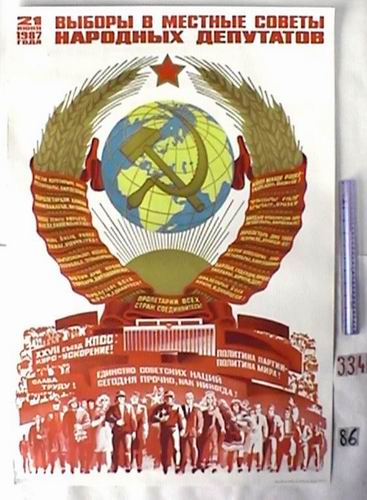 There are many who dismiss Communism as ultimately impractical on the grounds that it is against human nature. They claim that Communism asks humans to be altruists, which they cannot become. It tries to treat all humans as equals, while they are not. It exhorts humans to live a peaceful life through cooperation and sharing as against competition and constant struggle for survival, which they cannot do due to their animal instincts.